
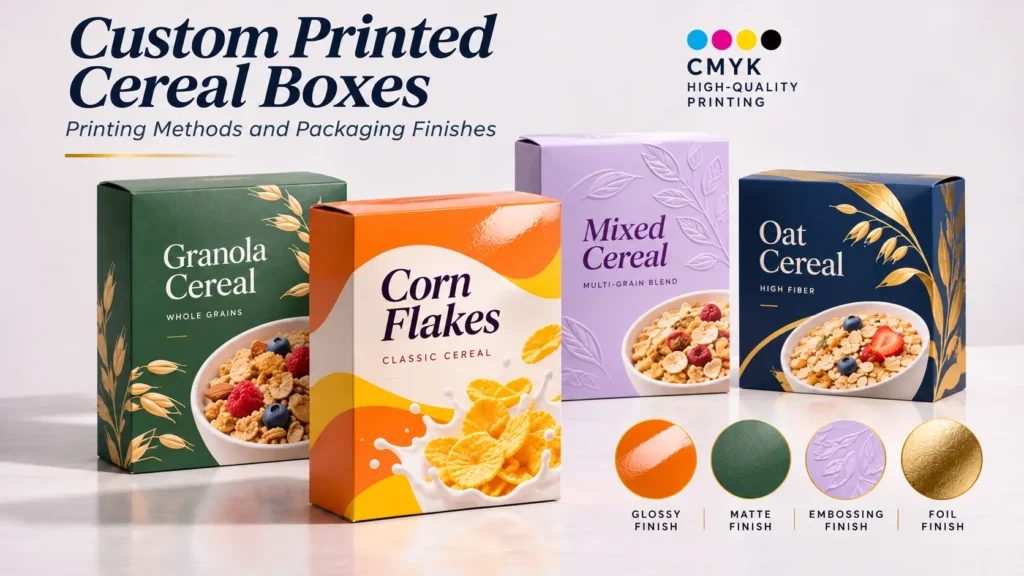
Custom printed cereal boxes help food brands create recognizable packaging, showcase product information, and maintain consistent branding across retail product lines. High-quality cereal box printing combines suitable printing methods, accurate colors, clear graphics, and appropriate surface finishes.
For cereal manufacturers, private-label brands, and packaging buyers, understanding printing specifications is essential before placing a production order.
OnePlusOne Packaging provides OEM and ODM paper packaging services, including artwork preparation, printing, finishing, sampling, and mass production. This guide explains how cereal boxes are printed, the available printing techniques, and how to achieve consistent packaging results.
What Are Custom Printed Cereal Boxes?
Custom-printed cereal boxes are paperboard cartons featuring personalized logos, graphics, product information, and brand colors. Unlike plain cartons, printed packaging allows businesses to present a consistent brand identity across different cereal products.
Custom printing can include product illustrations, flavor names, nutritional information, barcodes, and promotional messages.
For businesses exploring additional packaging options, our custom cereal boxes guide covers box structures, dimensions, materials, and complete customization solutions.
Benefits of Custom Cereal Box Printing
Custom printed cereal packaging offers several advantages:
Creates recognizable brand packaging.
Supports consistent product presentation.
Displays important product information.
Allows different designs for multiple flavors.
Provides flexible printing and finishing options.
For brands managing several products, maintaining consistent print specifications is especially important for repeat orders.
Common Cereal Box Printing Methods
Commercial cereal cartons are often produced using offset printing. Depending on the artwork, different color configurations can be selected, including CMYK, Pantone spot colors, and single-color printing.
CMYK Printing
CMYK printing combines cyan, magenta, yellow, and black inks to reproduce multicolor graphics and images.
It is commonly used for cereal packaging featuring product photography, illustrations, colorful backgrounds, and detailed artwork.
Best for: Colorful retail cereal packaging with complex graphics.
Pantone Color Printing
Pantone printing uses specified spot colors for designs requiring particular brand colors.
This option can be useful when brands need consistent logo colors across different cereal packaging products.
However, printed color appearance may vary depending on paperboard surfaces and finishing treatments.
Best for: Brand-specific colors and important visual elements.
Single-Color Printing
Single-color printing uses one ink color for the packaging artwork.
It is suitable for simple logos, typography, line illustrations, and minimalist packaging designs.
Best for: Simple packaging designs with limited color requirements.
CMYK vs. Pantone vs. Single-Color Printing
| Printing Option | Main Feature | Suitable Application |
|---|---|---|
| CMYK Printing | Multicolor graphics and images | Colorful cereal cartons |
| Pantone Printing | Specified spot colors | Brand color matching |
| Single-Color Printing | One ink color | Minimalist packaging |
The final selection depends on artwork complexity, brand requirements, printing costs, and production specifications.
Artwork Preparation for Cereal Box Printing
Preparing accurate artwork is essential for successful custom cereal box printing. Incorrect files can lead to unexpected color differences, misplaced graphics, or cutting problems.
Check the Cereal Box Dieline
A dieline shows the cutting lines, folding lines, and panel positions of the carton.
Artwork must be arranged according to the approved dieline to ensure that important design elements remain correctly positioned after folding.
Prepare High-Resolution Images
Product images and graphics should be suitable for the final printing size.
Low-resolution images may appear blurry or pixelated on printed packaging.
For raster artwork, 300 PPI at the final printed size is a common preparation target, although the required resolution depends on the artwork and printing process.
Confirm Colors and Typography
Before submitting artwork, buyers should check:
CMYK color settings.
Pantone color references, if required.
Logo placement.
Text readability.
Font availability or outlined text.
Barcode position.
Bleed and safe areas.
Verify Product Information
Cereal packaging artwork often contains ingredients, nutritional information, net weight, and other product details.
The responsible food brand should verify the accuracy of this information and compliance with the labeling requirements of its target market before final print approval.
Surface Finishing Options for Printed Cereal Boxes
Surface finishing affects the visual appearance and texture of printed packaging. Different finishes can highlight graphics, change reflectivity, or create decorative effects.
Gloss Lamination
Gloss lamination creates a shiny, reflective surface. It can make colorful graphics appear more vibrant and give the carton a polished appearance.
Suitable for: Bright cereal packaging designs and colorful retail presentations.
Matte Lamination
Matte lamination creates a smooth, less reflective finish.
It is suitable for packaging designs that require a softer, more understated appearance.
Suitable for: Minimalist cereal packaging and selected premium designs.
Gloss and Matte Varnishing
Varnishing applies a coating to the printed surface.
Gloss varnishing provides a reflective finish, while matte varnishing produces a lower-gloss appearance.
The appropriate option depends on the paperboard, printing requirements, and desired surface effect.
Spot UV Coating
Spot UV applies a glossy effect to selected areas of a design.
It can highlight brand logos, product names, or decorative graphics against a contrasting surface.
Suitable for: Packaging with selected visual highlights.
Gold and Silver Foil Stamping
Foil stamping creates metallic decorative effects.
Gold and silver finishes may be considered for seasonal products, promotional gift packaging, or premium cereal collections.
Embossing and Debossing
Embossing raises selected elements above the paper surface, while debossing creates recessed details.
These techniques can add texture to logos and packaging graphics.
Printing Finish Comparison
| Finishing | Visual Effect | Suggested Application |
|---|---|---|
| Gloss Lamination | Reflective surface | Colorful retail packaging |
| Matte Lamination | Low-gloss surface | Minimalist packaging |
| Gloss Varnishing | Shiny coating | Printed carton graphics |
| Matte Varnishing | Subtle finish | Understated packaging |
| Spot UV | Localized gloss | Highlighted logos |
| Foil Stamping | Metallic decoration | Promotional packaging |
| Embossing | Raised texture | Premium brand details |
Finishing should be selected according to the design, material compatibility, budget, and intended packaging application.
How Are Cereal Boxes Printed?
Custom cereal box printing involves a coordinated production process from artwork approval to finished carton inspection.
Step 1: Artwork and Dieline Confirmation
The manufacturer checks the artwork against the carton dieline, including panel positions, cutting lines, and folding areas.
Step 2: Color and Material Confirmation
The buyer confirms the printing colors, paperboard specifications, and surface finishing requirements.
Pantone references and other important color requirements should be agreed upon before production.
Step 3: Printing Production
The approved artwork is printed onto the selected paperboard.
Offset printing is commonly used for commercial paperboard packaging because it supports detailed graphics and repeatable production.
Step 4: Surface Finishing
After printing, the sheets undergo the selected finishing processes, such as lamination, varnishing, or decorative treatments.
Step 5: Die-Cutting and Creasing
Printed paperboard is cut and creased according to the approved carton structure.
Accurate cutting and folding positions help maintain the intended packaging appearance.
Step 6: Folding and Gluing
The printed cartons are folded and glued as required by their structure.
Many folding cartons are supplied flat for convenient packing and transportation.
Step 7: Final Quality Inspection
Finished cartons are checked for printing defects, color consistency, cutting accuracy, and finishing quality before packing and shipment.
How to Maintain Printing Quality and Color Consistency
For cereal brands, consistent printing is essential when producing multiple product variations or placing repeat orders.
Approve Printed Samples
Printed samples allow buyers to review colors, typography, image quality, and finishing before mass production.
When color accuracy is important, buyers should confirm the appropriate print proof or physical color reference with their manufacturer.
Maintain Consistent Brand Colors
Using confirmed CMYK specifications or Pantone references helps manufacturers understand the required colors.
However, actual appearance may change with paperboard surfaces, coatings, and production conditions.
Check Important Printing Details
Quality inspection should include:
Logo and text clarity.
Color consistency.
Print registration.
Artwork alignment.
Surface finishing defects.
Barcode readability.
Keep Approved Production References
For repeat orders, brands should retain the approved artwork, color references, and packaging specifications.
These records help reduce unnecessary changes and support more consistent packaging production.
Custom Printing for Different Cereal Product Lines
Cereal brands often offer multiple flavors, product sizes, and packaging variations. Custom printing allows these products to share a consistent visual identity while displaying different information.
Consistent Branding Across Flavors
Brands can maintain the same logo, typography, and layout while changing colors or product images for each flavor.
This approach helps customers recognize different products within the same brand family.
Printing for Private-Label Cereal Brands
Private-label businesses can use custom printed cereal packaging to establish their own brand identity.
Artwork may include customized logos, product descriptions, nutritional information, and retailer-specific branding.
Printing for Promotional Packaging
Special cereal product launches and seasonal promotions may require different artwork or decorative finishes.
These variations should be planned around the production quantity, printing specifications, and required delivery schedule.
Managing Repeat Printing Orders
For multiple product variations, buyers should provide clear artwork file names, approved design versions, and product-specific specifications.
Maintaining organized files helps reduce printing errors and unnecessary production adjustments.
Why Choose OnePlusOne Packaging for Cereal Box Printing?
OnePlusOne Packaging provides custom paper packaging manufacturing and OEM/ODM services for overseas B2B customers.
Custom Printing Services
Our printing options include CMYK printing, Pantone color printing, and single-color printing for suitable paper packaging projects.
Printing and Finishing Capabilities
Our manufacturing capabilities include Heidelberg printing equipment, lamination, varnishing, die-cutting, gluing, and selected decorative finishing processes.
OEM and ODM Packaging Manufacturing
With over 13 years of OEM/ODM experience, we support customized packaging projects from artwork preparation and structural development to production.
Sampling and Quality Inspection
Sample development generally takes 3–5 days, depending on project requirements.
We carry out quality checks before packing to help ensure that the finished packaging meets the approved specifications.
Our general MOQ starts at 500 pieces, subject to project confirmation.
Frequently Asked Questions About Custom Printed Cereal Boxes
What printing methods are used for cereal boxes?
Offset printing commonly uses CMYK, Pantone spot colors, or single-color configurations.
Can I print my own logo on cereal boxes?
Yes. Custom logos, graphics, product details, and brand colors can be printed on cereal cartons.
What is the difference between CMYK and Pantone?
CMYK combines four process inks, while Pantone uses specified spot colors for particular color requirements.
What finishes are available for cereal boxes?
Options include gloss or matte lamination, varnishing, Spot UV, foil stamping, embossing, and debossing.
How can I ensure consistent printing colors?
Provide approved artwork, color specifications, and print references, and review samples before production.
What is the MOQ for custom printed cereal boxes?
OnePlusOne Packaging generally starts at 500 pieces, depending on printing and packaging specifications.
Get a Quote for Custom Printed Cereal Boxes
Looking for a reliable manufacturer of custom printed cereal boxes?
OnePlusOne Packaging provides printing, finishing, sampling, and OEM/ODM paper packaging services for food brands, retailers, wholesalers, and distributors.
Whether you need full-color cereal packaging, precise brand colors, or decorative printing finishes, our team can help evaluate your requirements.
Please provide your box dimensions, artwork, printing specifications, finishing preferences, and estimated order quantity to request a quotation.
Contact OnePlusOne Packaging for custom printed cereal boxes and professional packaging manufacturing solutions.