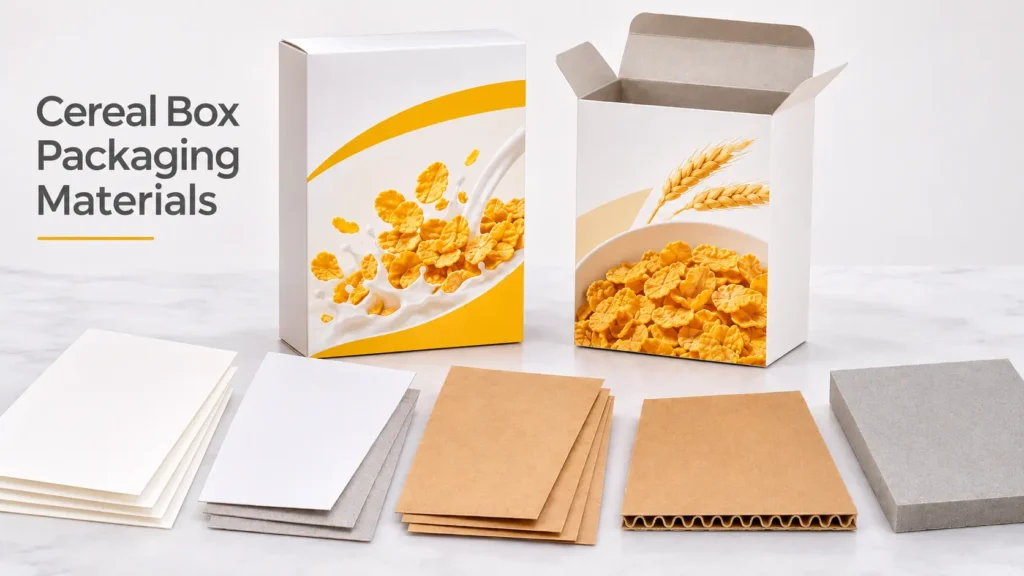
Cereal box packaging materials affect carton strength, printing quality, appearance, and production costs. Common materials used in custom paper packaging include ivory board, CCNB, kraft paper, and specialty paper. Each offers different characteristics for folding cartons and other packaging applications.
For cereal brands, manufacturers, and wholesalers, choosing the right material means balancing paperboard thickness, printing requirements, structural performance, and budget.
This guide explains the main cereal box materials, their specifications, and how to select suitable paperboard for custom packaging.
What Are Cereal Box Packaging Materials?
Cereal box packaging materials are paper-based materials used to manufacture outer cartons for breakfast cereal products. Paperboard is commonly used because it is lightweight, printable, and suitable for folding carton structures.
Most conventional cereal packaging consists of a paperboard outer carton and a separate inner food bag. The carton provides branding and structural support, while the inner bag holds the cereal.
For businesses exploring different box structures, materials, printing, and manufacturing options, our custom cereal boxes guide provides an overview of customized packaging solutions.
Why Choose Paperboard Cereal Boxes?
-
Lightweight and customizable structures.
-
Printable surfaces for logos and graphics.
-
Different paper weights and finishes.
-
Efficient flat storage before assembly.
-
Suitable for retail product presentation.
The best cereal box material depends on the product, carton size, printing requirements, and intended use.
Common Types of Paperboard for Cereal Boxes
Several paper materials can be used for custom cereal packaging projects. Their suitability depends on the carton structure and required performance.
Single-Side Coated Ivory Board
Single-side coated ivory board, also called white card paper, has a smooth coated surface on one side and a slightly rougher reverse.
It is widely used for folding cartons, food-related outer packaging, and cosmetic boxes.
Paper Weight: 250–400 GSM.
OnePlusOne Packaging frequently uses 350 GSM as a quotation reference for ivory board packaging.
Its smooth surface makes ivory board a useful option for cereal cartons requiring colorful printing and clear product information.
CCNB – Clay Coated News Back
CCNB, also known as grey-back white board, has a white coated front and a grey reverse side.
It is used for different paper box applications and can offer a relatively economical material option.
Paper Weight: 250–400 GSM.
CCNB may be considered for cereal outer cartons when the required stiffness, printing quality, and packaging specifications are satisfied.
Kraft Paper
Kraft paper is available in natural brown and white varieties. It is used for paper bags, food-related packaging, mailer boxes, and other paper packaging products.
Paper Weight: 80–400 GSM.
Suitable kraft paperboard grades can be considered for cereal packaging with a natural paper appearance. Printing results and structural performance should be confirmed before production.
Other Paper Materials
Additional materials used in custom paper packaging include:
-
Double-Side Coated Paper: 80–400 GSM, with smooth printable surfaces on both sides.
-
Specialty Paper: 120–400 GSM, available in different colors and textures.
-
Gold and Silver Cardboard: 153–325 GSM, featuring reflective metallic surfaces.
These materials are generally more relevant to selected printed components or promotional packaging than ordinary retail cereal cartons.
Cereal Box Material Comparison
| Material | GSM Range | Main Characteristics |
|---|---|---|
| Ivory Board | 250–400 | Smooth white printing surface |
| CCNB | 250–400 | White front, grey reverse |
| Kraft Paper | 80–400 | Natural brown or white appearance |
| Double-Side Coated Paper | 80–400 | Printable on both sides |
| Specialty Paper | 120–400 | Various colors and textures |
| Gold / Silver Cardboard | 153–325 | Reflective metallic finish |
These ranges describe available material categories, not recommended weights for every cereal box.
Cereal Box Paperboard Thickness and Strength
Paperboard weight and thickness influence the stiffness, folding performance, and structural stability of cereal cartons.
What Is Paperboard GSM?
GSM means grams per square meter. It measures the weight of one square meter of paper.
For example:
-
250 GSM: 250 grams per square meter.
-
300 GSM: 300 grams per square meter.
-
350 GSM: 350 grams per square meter.
-
400 GSM: 400 grams per square meter.
Higher GSM within a comparable board grade often means more material, but GSM does not directly determine thickness or strength.
How to Choose the Right Paperboard Weight
When selecting paperboard, consider:
-
Carton dimensions and structure.
-
Product weight and volume.
-
Inner food bag dimensions.
-
Folding and assembly requirements.
-
Storage and transportation conditions.
A 350 GSM ivory board specification may be evaluated for a custom folding carton, but the final material should be confirmed through structural sampling.
Paperboard vs. Corrugated Board for Cereal Packaging
Paperboard and corrugated board serve different packaging purposes.
Paperboard for Retail Cereal Boxes
Ivory board and suitable CCNB grades are options for folding retail cartons. They provide printable surfaces for product information, logos, and branding.
Corrugated Board for Shipping Boxes
Corrugated board contains fluted layers that provide additional structural support and cushioning during transportation.
OnePlusOne Packaging works with E, F, and B flute structures. A commonly used material construction is 250–300 GSM CCNB laminated to E-flute corrugated board.
Corrugated cartons are commonly used as outer shipping packaging for multiple retail cereal boxes.
Grey Board for Rigid Packaging
Grey board is a thick, rigid material commonly used for premium gift boxes.
Paper Weight: 800–1600 GSM.
It may be considered for special cereal gift packaging, but it is not normally required for conventional folding retail cartons.
Printing and Finishing for Cereal Box Materials
Printing and finishing influence the final appearance of custom cereal packaging.
Printing Options
OnePlusOne Packaging’s printing processes include:
-
CMYK Printing: Suitable for colorful graphics and product images.
-
Pantone Color Printing: Used for specific brand colors.
-
Single-Color Printing: Suitable for simpler packaging designs.
Surface Finishing Options
| Finishing | Effect |
|---|---|
| Gloss Lamination | Smooth, glossy appearance |
| Matte Lamination | Smooth, less reflective finish |
| Gloss Varnishing | Glossy coated surface |
| Matte Varnishing | Lower-gloss coated surface |
| Gold / Silver Foil Stamping | Metallic decoration |
| Embossing / Debossing | Raised or recessed details |
| Spot UV | Localized glossy effect |
For standard retail cereal packaging, readable product information and consistent printing are generally more important than elaborate decorative finishes.
The selected finishing process should be compatible with the paperboard and packaging requirements.
Food Safety and Sustainable Material Considerations
Food Packaging Safety
Most conventional cereal cartons are used as outer packaging, while a separate inner bag directly contains the cereal.
The inner packaging should meet applicable food-contact and barrier requirements for the intended product and target market.
Ordinary printed paperboard should not automatically be considered suitable for direct food contact.
Sustainable Packaging Considerations
Brands can evaluate material efficiency by choosing suitable paperboard weights, optimizing carton dimensions, and avoiding unnecessary packaging components.
Lamination, coatings, and material composition may affect recyclability. Buyers should verify actual material specifications and local recycling requirements before making environmental claims.
How to Choose the Best Cereal Box Material
Choosing the right cereal box material requires balancing packaging performance, visual appearance, and cost.
Consider Your Packaging Requirements
For conventional retail folding cartons, buyers can begin by evaluating ivory board and suitable CCNB grades.
Kraft paperboard may be considered for natural-style packaging, while corrugated board is more relevant to shipping cartons.
Compare Material Quality and Cost
Material costs depend on paperboard grade, GSM, carton dimensions, printing, and finishing.
The most expensive paperboard is not necessarily the best option. The selected material should meet the required structural and printing specifications.
Request Samples Before Bulk Production
Before approving an order, check:
-
Paperboard stiffness.
-
Folding performance.
-
Printing quality.
-
Surface finishing.
-
Finished carton dimensions.
-
Compatibility with the inner food bag.
Sample testing helps identify material or structural adjustments before mass production.
Why Choose OnePlusOne Packaging?
OnePlusOne Packaging provides OEM and ODM custom paper packaging solutions for overseas brands, wholesalers, and distributors.
Our services include material selection, carton structural development, printing, finishing, sampling, quality inspection, and bulk production.
We offer different paper material options, including ivory board, CCNB, kraft paper, specialty paper, corrugated board, and grey board.
With more than 13 years of OEM/ODM experience, we support custom packaging projects according to customers’ specifications.
Our general MOQ starts at 500 pieces, while sample development typically takes 3–5 days, depending on project requirements.
Frequently Asked Questions
What material is used for cereal boxes?
Retail cereal boxes commonly use paperboard. Ivory board and suitable CCNB grades are materials that can be evaluated.
Is ivory board suitable for cereal packaging?
Yes. Ivory board can be used for folding outer cartons when its specifications meet the packaging requirements.
What GSM is suitable for cereal boxes?
The appropriate GSM depends on box dimensions, structure, and board grade. Sample testing helps confirm suitability.
Can kraft paper be used for cereal boxes?
Yes. Suitable kraft paperboard grades can be considered for cereal outer packaging with a natural appearance.
What is the difference between CCNB and ivory board?
Ivory board has a smooth white coated side, while CCNB features a white coated front and grey reverse.
Get Custom Cereal Box Packaging Materials
Selecting suitable cereal box packaging materials helps businesses balance strength, printing quality, appearance, and manufacturing costs.
OnePlusOne Packaging provides custom paper packaging services, including material selection, structural development, sampling, printing, and mass production.
Send us your box dimensions, preferred material, estimated order quantity, and artwork or reference images to discuss your packaging requirements.
Contact OnePlusOne Packaging for custom cereal box packaging materials and a quotation.