
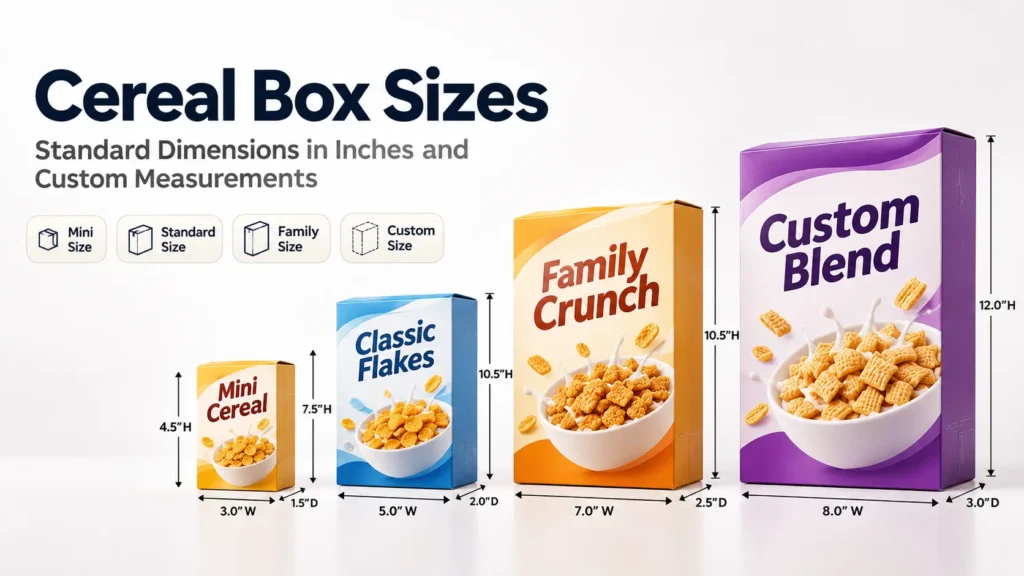
Cereal box sizes vary depending on the product type, net weight, inner packaging, and retail requirements. A typical retail cereal box is approximately 12 inches tall, 8 inches wide, and 2–2.5 inches deep, although actual dimensions differ between brands and products.
For cereal manufacturers, private-label brands, and packaging buyers, choosing the right dimensions is essential for maintaining an attractive carton structure, accommodating the inner food bag, and managing packaging costs.
This guide explains standard cereal box sizes, dimensions in inches and centimeters, measurement methods, and how to select custom carton dimensions for different cereal products.
What Are Standard Cereal Box Sizes?
A standard size cereal box generally refers to the dimensions commonly used for retail breakfast cereal packaging. However, there is no universal size that applies to every cereal brand or product.
Many conventional cereal cartons have a rectangular folding carton structure, with a relatively wide front panel and narrow side panels.
What Is the Standard Size of a Cereal Box?
A commonly referenced standard cereal box size is approximately:
-
Height: 12 inches
-
Width: 8 inches
-
Depth: 2–2.5 inches
These measurements are useful starting points for packaging development, but they should not be treated as mandatory industry specifications.
The final carton dimensions depend on the product volume, inner bag, filling method, and retail requirements.
Why Do Cereal Box Sizes Vary?
Several factors influence cereal box dimensions:
Product Type: Different cereals have different shapes, densities, and packing characteristics. Granola, corn flakes, and puffed cereals may require different carton volumes even at the same net weight.
Net Weight: Larger product quantities generally require more packaging capacity, although weight alone cannot determine the exact box size.
Inner Packaging: The dimensions of the sealed food bag influence the minimum space required inside the carton.
Retail Requirements: Shelf height, display width, and product positioning can affect the preferred carton proportions.
Brand Preferences: Manufacturers may select different dimensions to support brand identity, product differentiation, or packaging efficiency.
For these reasons, businesses should confirm the final dimensions through product measurements and sample testing.
Cereal Box Dimensions in Inches
Cereal box dimensions in inches are commonly used by buyers in the United States and other markets that rely on imperial measurements.
When communicating specifications to a packaging manufacturer, it is important to indicate the measurement order and whether the dimensions refer to the inside or outside of the carton.
Common Cereal Box Dimensions Chart
The following table provides illustrative dimensions for different cereal packaging formats.
| Cereal Box Type | Height (in) | Width (in) | Depth (in) |
|---|---|---|---|
| Mini / Single Serve | 6 | 4 | 1.5 |
| Standard Retail | 12 | 8 | 2.5 |
| Family Size | 14 | 9 | 3 |
| Custom Size | Customized | Customized | Customized |
Note: These are approximate planning examples, not standardized industry dimensions. Actual sizes vary by product, brand, and packaging specifications.
Cereal Box Dimensions in Inches and Centimeters
International packaging buyers often need to convert imperial measurements into metric units.
| Box Type | Inches (H × W × D) | Centimeters (H × W × D) |
|---|---|---|
| Mini | 6 × 4 × 1.5 | 15.24 × 10.16 × 3.81 |
| Standard | 12 × 8 × 2.5 | 30.48 × 20.32 × 6.35 |
| Family | 14 × 9 × 3 | 35.56 × 22.86 × 7.62 |
One inch equals 2.54 centimeters or 25.4 millimeters.
For manufacturing purposes, dimensions are often confirmed in millimeters to support accurate dieline development and production specifications.
Standard vs. Custom Cereal Box Dimensions
Standard reference sizes provide a convenient starting point for packaging planning.
However, custom dimensions allow brands to develop cartons according to their actual products rather than adapting products to predetermined packaging.
Custom sizing is especially useful for private-label brands, new cereal products, and businesses introducing multiple packaging formats.
How to Measure the Dimensions of a Cereal Box
Accurate measurements are important when ordering new packaging or reproducing an existing cereal carton.
For a typical upright rectangular cereal box, three measurements describe its basic shape: height, width, and depth.
Step 1: Measure the Height
Place the cereal box upright on a flat surface.
Measure vertically from the bottom of the carton to the top edge. This is the height.
Step 2: Measure the Width
Measure horizontally across the front panel, from its left edge to its right edge.
The front-panel width affects the available space for branding, product information, and graphics.
Step 3: Measure the Depth
Measure the distance between the front and back panels.
The depth determines how thick the carton is and influences its overall packaging capacity.
Step 4: Confirm Internal and External Dimensions
Internal dimensions describe the usable space inside the carton. External dimensions describe its finished outside measurements.
These measurements are not identical because paperboard has thickness, and the folding structure affects the finished carton.
When ordering custom packaging, buyers should clearly specify whether they are providing internal or external dimensions.
For example, a carton that must accommodate a particular sealed cereal bag should be developed around the required usable internal space.
How to Calculate Cereal Box Volume
The approximate geometric volume of a rectangular cereal box can be calculated using:
Volume = Height × Width × Depth
For example, consider a carton with the following dimensions:
-
Height: 12 inches
-
Width: 8 inches
-
Depth: 2.5 inches
The calculation is:
12 × 8 × 2.5 = 240 cubic inches
This is equivalent to approximately 3.93 liters of rectangular volume.
However, exterior volume is not the same as usable internal capacity or actual cereal fill volume. Paperboard thickness, the inner bag, headspace, and product density must also be considered.
Different Cereal Box Sizes for Different Products
Different cereal products and sales channels may require different packaging formats.
The following categories can help buyers understand common size-related applications.
Mini and Single-Serve Cereal Boxes
Mini cereal boxes are suitable for individual portions, samples, hospitality applications, and promotional packs.
Their compact dimensions make them useful when brands want to distribute smaller product quantities.
Regular Retail Cereal Boxes
Regular cereal boxes are commonly used for products sold through supermarkets and grocery stores.
The dimensions should provide enough internal space for the product while maintaining practical retail display proportions.
Family-Size Cereal Boxes
Family-size cartons are generally developed for larger product quantities.
These cartons may require wider panels, greater depth, or additional height depending on the cereal and inner bag dimensions.
The final material specification should also account for the larger carton structure.
Custom Small Cereal Boxes
Custom small cereal boxes allow brands to develop compact packaging in dimensions that differ from common retail references.
They may be suitable for sample programs, promotional campaigns, small product portions, or selected private-label applications.
Importantly, the same product weight does not always require the same carton dimensions. Product density, bag shape, and filling characteristics should be evaluated before confirming the box size.
How to Choose the Right Cereal Box Size
Choosing the right cereal box size requires balancing product requirements, carton proportions, retail presentation, and packaging efficiency.
Consider Cereal Weight and Volume
Start by identifying the intended net weight and approximate filled product volume.
For example, two cereal products with the same net weight may occupy different amounts of space because their shapes and densities differ.
Manufacturers should use actual product measurements or filling data rather than selecting a carton solely by weight.
Measure the Inner Food Bag
Most conventional cereal packaging systems use an inner food bag inside the paperboard carton.
Buyers should confirm the bag’s dimensions when filled and sealed, including any space required for folds or closure areas.
The paperboard carton must provide sufficient usable internal space without unnecessarily increasing the overall package size.
Consider Retail Shelf Requirements
Retail display conditions can influence carton height, width, and depth.
Before confirming the dimensions, brands may need to consider:
-
Available shelf height.
-
Front-panel display space.
-
Number of products displayed side by side.
-
Shelf arrangement requirements.
-
Transportation and storage dimensions.
Reduce Unnecessary Empty Space
An oversized carton can increase paperboard consumption, transportation volume, and storage requirements.
However, reducing dimensions too aggressively may interfere with packing or product presentation.
The goal is to develop a practical carton that accommodates the product and inner bag without excessive unused space.
Test the Box Before Mass Production
A structural sample is an effective way to check the selected dimensions.
During testing, buyers should verify that the inner bag fits, the carton closes correctly, and the structure maintains its intended appearance.
Samples can also help identify adjustments before printing and mass production begin.
How Cereal Box Dimensions Affect Packaging Costs
Cereal box dimensions influence material consumption, production efficiency, and shipping requirements.
For businesses purchasing packaging in bulk, even small changes in carton dimensions may affect overall project costs.
Paperboard Material Consumption
Larger cartons generally require more paperboard.
However, total material consumption also depends on the carton structure, dieline layout, cutting arrangement, and production requirements.
Printing and Die-Cutting Requirements
Carton dimensions affect how unfolded box layouts are arranged on printing sheets.
Different dimensions may change the number of cartons produced from each sheet and the efficiency of die-cutting.
Shipping and Storage Efficiency
The dimensions of finished cartons influence retail handling and product distribution.
For cartons supplied flat, the unfolded size and packing arrangement also affect storage and shipping requirements.
Packaging Size Consistency
Brands with several cereal products may benefit from coordinating carton dimensions where practical.
Using consistent specifications across product lines can simplify packaging planning, repeat orders, and inventory management.
However, the final dimensions should always remain suitable for the actual products.
Custom Cereal Box Sizes for Your Brand
Custom dimensions allow businesses to develop packaging that meets their specific product requirements rather than relying on common retail measurements.
For food brands looking beyond standard dimensions, our custom cereal boxes offer flexible packaging solutions with customized structures, materials, printing, and finishing options.
Custom Dimensions for Different Cereal Products
Custom cartons can be developed for different cereal types, product quantities, and inner bag configurations.
Buyers can provide existing packaging samples, dimensional requirements, or reference drawings to help the manufacturer understand the project.
Custom Folding Carton Structures
Folding cartons can be customized according to the required dimensions, closure design, and packaging process.
The structure should be selected based on the product, packaging equipment, and intended use.
Dieline Development and Sampling
After the required dimensions are confirmed, a dieline can be developed to define the carton panels, folds, and cutting areas.
A structural sample allows buyers to check the finished dimensions and determine whether adjustments are necessary.
Custom Packaging for Private-Label Brands
Private-label businesses may need several carton sizes for different product weights or flavors.
A coordinated packaging system can help maintain consistent branding while allowing dimensional changes according to individual product requirements.
Why Choose OnePlusOne Packaging for Custom Cereal Box Sizes?
OnePlusOne Packaging provides custom paper packaging manufacturing and OEM/ODM services for overseas brands, wholesalers, distributors, and procurement teams.
Our services support businesses that require customized carton dimensions, printing, and bulk production.
Custom Paper Box Manufacturing
We provide paper packaging solutions covering structural development, material selection, printing, finishing, and manufacturing.
Buyers can share their required dimensions, existing box samples, or product specifications for project evaluation.
Packaging Structure and Dimension Support
Our team can assist with carton structure development and dimensional specifications based on the customer’s requirements.
Samples can be developed to help confirm the finished carton before mass production.
Sampling and Quality Inspection
Sample development generally takes 3–5 days, depending on project requirements.
Quality checks are carried out before packing to help verify that finished cartons meet the confirmed production specifications.
Bulk Packaging Production
OnePlusOne Packaging’s manufacturing capabilities include:
-
13+ years of OEM/ODM experience.
-
A 1200+㎡ manufacturing facility.
-
More than 150 employees.
-
Over 94 sets of production equipment.
-
Approximately 680,000 paper boxes of monthly production capacity.
Our general MOQ starts at 500 pieces for custom packaging projects, subject to confirmation of the specific requirements.
Frequently Asked Questions About Cereal Box Sizes
What is the standard size of a cereal box?
A common reference is approximately 12 inches high, 8 inches wide, and 2–2.5 inches deep. Actual dimensions vary by brand and product.
What are cereal box dimensions in inches?
Cereal box dimensions are commonly expressed as height, width, and depth. For example, 12 × 8 × 2.5 inches describes one typical reference carton.
How tall is a typical cereal box?
Many regular retail cereal cartons are approximately 10–12 inches tall, but the actual height depends on the product and packaging design.
What are the dimensions of a family-size cereal box?
Family-size cartons vary by brand and product. A 14 × 9 × 3-inch carton is one illustrative size for larger packaging, not a universal specification.
Can I order cereal boxes in custom sizes?
Yes. OnePlusOne Packaging can discuss custom dimensions based on your product, inner bag, and structural requirements.
How do I measure a cereal box correctly?
Measure its height, front-panel width, and front-to-back depth. Specify whether you are providing internal or external dimensions when requesting a quote.
Get Custom Cereal Boxes in Your Required Size
Choosing suitable cereal box dimensions helps brands develop packaging that fits their products, supports retail presentation, and meets manufacturing requirements.
OnePlusOne Packaging provides OEM and ODM custom paper packaging solutions, including structural development, sampling, printing, and bulk production.
Whether you need small cereal cartons, regular retail packaging, or larger family-size boxes, our team can help evaluate your dimensional requirements.
For a quotation, please provide:
-
Required carton dimensions.
-
Cereal product type.
-
Inner bag measurements.
-
Estimated order quantity.
-
Artwork or reference images.
-
Delivery destination.
Contact OnePlusOne Packaging to discuss your custom cereal box sizes and request a packaging quotation.